This Thanksgiving is an unusual one for me, because I'm literally between jobs.
After nearly four years at a full-service marketing and advertising agency, I turned in my key last Friday said goodbye to many friends. As I made that final commute home, I felt nothing but excitement about my next venture.
Because of that, this week is a true stay-cation: While taking time off at work is always great, this is one week off where I don't have to feel like I'm missing anything or getting behind. My brain is getting a chance to relax and shift gears before I start my new job in downtown Indianapolis next week.
So this year, I'm thankful for change. New opportunities. New adventures. New challenges. New environments. New things to learn. New friends to meet.
Oh, and new foods to try, like this persimmon that has been sitting, lonely, on my countertop for five days while I try to figure out what to do with a single persimmon. (Besides photograph it.)
I'm thankful for free days of few obligations and the chance to let my brain and my body de-stress. I'm thankful for excitement. I'm thankful for optimism.
I'm thankful for little pleasures, like hearing fresh cranberries *pop* while cooking my annual cranberry sauce for our family gathering tomorrow.
I'm thankful for a family who is safe, healthy, and will spend this holiday together. I'm thankful for the health and presence of my four-legged family members, too. Life would be incomplete without them.
I'm thankful for a growing extended family that will include a baby in 2013, making me an aunt in spirit (though not on paper).
I'm thankful I've had the chance to spend yet another year being thankful.
Happy Thanksgiving to you! And thank you for being here.
Showing posts with label fruit. Show all posts
Thursday, November 22, 2012
Thursday, June 14, 2012
Wine tasting in Temecula
Pure vacation time begins!
Taking advantage of my work trip to California, I extended my stay by a few days, and my friend Sarah Lynn flew out and joined me. It worked out perfectly, because she was planning to fly to Los Angeles the following week for her husband's grandmother's 90th birthday gathering, so she came out early so we could explore southern California together.
Neither of us had been to San Diego before, so we focused our four days there. We chose to take an inland, scenic route from Newport Beach to San Diego, which took us through Temecula.
View Larger Map
It was a beautiful, winding drive through Cleveland National Forest. It really hit home for me how susceptible to wildfires this landscape is. The whole area of southern California I saw was much more arid than I expected, especially around San Diego. I didn't expect to see cacti unless I were to drive inland toward Death Valley, but they were really all over the place.
While the altitude of this particular "national forest" wasn't very high, the quantity of trees were far from my idea of a forest, and the landscape was populated more by scrub-type vegetation.
The weather inland differs dramatically from the weather along the coast of California. Our drive to Temecula was the hottest we experienced, with a high temperature in the upper 80s. I hear so many people say, "Oh, but it's a dry heat, it's not as bad," but I tell you what—it was hot!
Temecula is a town of about 100,000, but it was the local wine country that encouraged us to make a stop there. Last summer, on my trip to Traverse City, Mich. with Mom, I did my first wine-tasting—so I was interested to see how it compared to a California experience.
The area promotes at least 35 wineries—we stopped at four. That was all we could handle! The four we visited:
After a day of sweating and sampling wine, we continued our journey south, toward our hotel near Escondido. We'd heard from friends that roadside fruit and nut stands and avocado groves were plentiful outside Escondido, and since we both are big fans of fresh, local food, we really wanted to see this for ourselves.
I didn't get to see any avocado groves—and I was curious to see avocados in their element—but I certainly saw the plentiful evidence: Sarah Lynn and I were shocked to see roadside stand after stand advertising 25 avocados for $5.00. That's $0.20 each! I'm excited when we can find avocados for $1.00 each in Indiana, so this was unbelievable. Neither of us had a way to really transport or consume dozens of avocados back to Indiana, but we certainly laughed about the possibilities for selling them at a profit!
And let me tell you, we had fresh avocado on everything. Omelettes were topped with it. Salads featured it. Even Subway, which in some Indiana locations offers an avocado spread as a sandwich topping, in southern California had fresh, whole avocado on hand to slice individually for your order. I definitely enjoyed that!
Up next: La Jolla, which boasts some of the most expensive real estate in the country.
Taking advantage of my work trip to California, I extended my stay by a few days, and my friend Sarah Lynn flew out and joined me. It worked out perfectly, because she was planning to fly to Los Angeles the following week for her husband's grandmother's 90th birthday gathering, so she came out early so we could explore southern California together.
Neither of us had been to San Diego before, so we focused our four days there. We chose to take an inland, scenic route from Newport Beach to San Diego, which took us through Temecula.
View Larger Map
It was a beautiful, winding drive through Cleveland National Forest. It really hit home for me how susceptible to wildfires this landscape is. The whole area of southern California I saw was much more arid than I expected, especially around San Diego. I didn't expect to see cacti unless I were to drive inland toward Death Valley, but they were really all over the place.
While the altitude of this particular "national forest" wasn't very high, the quantity of trees were far from my idea of a forest, and the landscape was populated more by scrub-type vegetation.
The weather inland differs dramatically from the weather along the coast of California. Our drive to Temecula was the hottest we experienced, with a high temperature in the upper 80s. I hear so many people say, "Oh, but it's a dry heat, it's not as bad," but I tell you what—it was hot!
Temecula is a town of about 100,000, but it was the local wine country that encouraged us to make a stop there. Last summer, on my trip to Traverse City, Mich. with Mom, I did my first wine-tasting—so I was interested to see how it compared to a California experience.
The area promotes at least 35 wineries—we stopped at four. That was all we could handle! The four we visited:
- Leonesse Cellars: This one was personally recommended by one of my clients, so we went there first.
- Danza del Sol Winery
- Ponte Family Estate Winery
- South Coast Winery: It was chosen Best California State Winery of the Year for the last two years, so we were definitely curious to see if it lived up to the award.
After a day of sweating and sampling wine, we continued our journey south, toward our hotel near Escondido. We'd heard from friends that roadside fruit and nut stands and avocado groves were plentiful outside Escondido, and since we both are big fans of fresh, local food, we really wanted to see this for ourselves.
I didn't get to see any avocado groves—and I was curious to see avocados in their element—but I certainly saw the plentiful evidence: Sarah Lynn and I were shocked to see roadside stand after stand advertising 25 avocados for $5.00. That's $0.20 each! I'm excited when we can find avocados for $1.00 each in Indiana, so this was unbelievable. Neither of us had a way to really transport or consume dozens of avocados back to Indiana, but we certainly laughed about the possibilities for selling them at a profit!
And let me tell you, we had fresh avocado on everything. Omelettes were topped with it. Salads featured it. Even Subway, which in some Indiana locations offers an avocado spread as a sandwich topping, in southern California had fresh, whole avocado on hand to slice individually for your order. I definitely enjoyed that!
Up next: La Jolla, which boasts some of the most expensive real estate in the country.
Sunday, April 22, 2012
Apple blossoms
I'm not sure if I've ever actually eaten one of the apples grown on this tree, but the blossoms are so delicate and beautiful and draw me in every spring.
Apples are, hands-down, one of my favorite fruits. I love how versatile they are, whether you want to eat one all by itself, in a salad, in oatmeal, as dessert, with peanut butter, or cooked low and slow into homemade apple butter.
I also love that you can find decent apples in the grocery store during many months of year. Unlike strawberries or tomatoes, which are more delicate and have zero flavor outside their natural growing season, it seems like apples are a little heartier and are still worth eating.
Though nothing is better than fresh apples, grown locally, and picked just hours or days before.
We have another five months to wait in central Indiana before that time comes back around, though, so I'm content to enjoy the blossoms on the tree for now.
Apples are, hands-down, one of my favorite fruits. I love how versatile they are, whether you want to eat one all by itself, in a salad, in oatmeal, as dessert, with peanut butter, or cooked low and slow into homemade apple butter.
I also love that you can find decent apples in the grocery store during many months of year. Unlike strawberries or tomatoes, which are more delicate and have zero flavor outside their natural growing season, it seems like apples are a little heartier and are still worth eating.
Though nothing is better than fresh apples, grown locally, and picked just hours or days before.
We have another five months to wait in central Indiana before that time comes back around, though, so I'm content to enjoy the blossoms on the tree for now.
Saturday, April 14, 2012
Cherry blossoms
When it comes to cherries, my favorite way to eat them is fresh, straight off the tree. The best place to eat cherries is standing next to the tree, so you can eat the fruit within seconds of picking it.
You can't get food much fresher than that!
This small white blossom is only about 1.5" in diameter. It bloomed on my parents' cherry tree, a tree that produces small, tart cherries. When I was growing up, we had a huge cherry tree that was sadly toppled by a strong thunderstorm. This tree is its replacement, and it's doing well, though it's definitely an exercise in patience while we all wait for it to grow. It currently produces enough cherries for only about one cherry crisp each year.
Tart cherries are harder to find in stores than sweet or Bing cherries, because they aren't cultivated as often and tend to be more delicate and not do as well in transit. As a result, many people have probably never had tart cherries—but there's really nothing like them.
In the Midwest, Michigan is known for producing tart cherries. Traverse City, where Mom and I vacationed last summer, has an annual Cherry Festival that attracts thousands of visitors. The cherries were just starting to ripen when we were there (and we specifically skipped town before the festival craziness), so we were a week or two too early to try fresh, local Michigan cherries.
We weren't too early—or too late—for the good wine, though! I'll just have to make a trip back to catch cherry season again in the future.
You can't get food much fresher than that!
This small white blossom is only about 1.5" in diameter. It bloomed on my parents' cherry tree, a tree that produces small, tart cherries. When I was growing up, we had a huge cherry tree that was sadly toppled by a strong thunderstorm. This tree is its replacement, and it's doing well, though it's definitely an exercise in patience while we all wait for it to grow. It currently produces enough cherries for only about one cherry crisp each year.
Tart cherries are harder to find in stores than sweet or Bing cherries, because they aren't cultivated as often and tend to be more delicate and not do as well in transit. As a result, many people have probably never had tart cherries—but there's really nothing like them.
In the Midwest, Michigan is known for producing tart cherries. Traverse City, where Mom and I vacationed last summer, has an annual Cherry Festival that attracts thousands of visitors. The cherries were just starting to ripen when we were there (and we specifically skipped town before the festival craziness), so we were a week or two too early to try fresh, local Michigan cherries.
We weren't too early—or too late—for the good wine, though! I'll just have to make a trip back to catch cherry season again in the future.
Monday, January 2, 2012
Warm salads: my go-to cold-weather meal
Happy New Year! It's hard to believe that we've begun yet another year on the calendar, and it's time to get back to work after the holidays.
Today I want to share with you one of my favorite go-to meals for this time of year. It's a versatile dish I affectionately call a warm salad.
I started eating these a couple years ago when I found this recipe for a Cous Cous Salad with Winter Squash and Cranberries at TheKitchn. To be honest, I've never actually made the recipe exactly as written (which is not uncommon for me). But it's endlessly variable when you step back and look at the essential ingredients. What you'll need:
Whole grain: I like to fix a batch of whole grain and have enough on hand for several meals during the week. Try this super-easy baked brown rice from Alton Brown. It's amazing. You'll need a 1/2 cup or so of cooked grain for one serving.
Next, add your vegetable. Sweet potatoes and yams are easily cooked one at a time in the microwave like a baked potato. Depending on the size, I usually use about half of one sweet potato for one serving. Roasted beets are great, too. Whatever you pick, cook it (or warm up your leftovers) and add it to the whole grain.
Next, add your fruit. Apples are readily available right now, and they make a wonderful combination with both sweet potatoes and beets. I'm generous with the apples, so I usually dice one small apple for one serving.
Finally, add your protein (Whole Foods' wonderful raw cashews pictured here), cheese, if you like, and dressing.
I mentioned that my favorite cheese to use is feta. In the picture above, I've used feta cheese made from goat's milk. For the last year, I've reduced my dairy intake, and in many cases (milk in my tea, little bits of cheese), I reach for goat's milk as an alternative. The nutritionist I worked with last year recommended it for me primarily because you'll find lower levels of hormones in goat's milk as compared to traditional cow's milk. I've gotten used to it and really like this feta, which I get at Whole Foods.
Voila! A versatile, warm, satisfying meal that is easy to throw together on a week night after work. I made this for my mom a couple months ago for the first time, and she's now hooked, too. Enjoy!
Today I want to share with you one of my favorite go-to meals for this time of year. It's a versatile dish I affectionately call a warm salad.
I started eating these a couple years ago when I found this recipe for a Cous Cous Salad with Winter Squash and Cranberries at TheKitchn. To be honest, I've never actually made the recipe exactly as written (which is not uncommon for me). But it's endlessly variable when you step back and look at the essential ingredients. What you'll need:
- A whole grain, to form your base. In the original recipe, it's cous cous. I have brown rice a lot, and I've also had this with quinoa (with great success), buckwheat and millet, to name a few. Pick your favorite and go with it.
- A vegetable. Lately I've been using lots of sweet potatoes/yams, but I highly recommend butternut squash and beets, too. I've had it with broccoli, cauliflower, and other squashes, as well.
- Protein, usually in the form of nuts or beans. Again, pick your favorite, or what sounds good that day, and go with it.
- Fruit, whether dried or fresh.
- A little cheese, if you like. Feta is my favorite.
- And dressing. The original recipe has a dressing included, but I most often have this with an Italian vinaigrette.
Whole grain: I like to fix a batch of whole grain and have enough on hand for several meals during the week. Try this super-easy baked brown rice from Alton Brown. It's amazing. You'll need a 1/2 cup or so of cooked grain for one serving.
Next, add your vegetable. Sweet potatoes and yams are easily cooked one at a time in the microwave like a baked potato. Depending on the size, I usually use about half of one sweet potato for one serving. Roasted beets are great, too. Whatever you pick, cook it (or warm up your leftovers) and add it to the whole grain.
Next, add your fruit. Apples are readily available right now, and they make a wonderful combination with both sweet potatoes and beets. I'm generous with the apples, so I usually dice one small apple for one serving.
Finally, add your protein (Whole Foods' wonderful raw cashews pictured here), cheese, if you like, and dressing.
I mentioned that my favorite cheese to use is feta. In the picture above, I've used feta cheese made from goat's milk. For the last year, I've reduced my dairy intake, and in many cases (milk in my tea, little bits of cheese), I reach for goat's milk as an alternative. The nutritionist I worked with last year recommended it for me primarily because you'll find lower levels of hormones in goat's milk as compared to traditional cow's milk. I've gotten used to it and really like this feta, which I get at Whole Foods.
Voila! A versatile, warm, satisfying meal that is easy to throw together on a week night after work. I made this for my mom a couple months ago for the first time, and she's now hooked, too. Enjoy!
Monday, December 5, 2011
Fresh pomegranates in season
Let's start this post with a little two-question poll:
1. Have you ever bought, opened, and eaten a fresh pomegranate?
a. Yes
b. No
c. Maybe, but I'm so consumed with holiday stress that I can't remember what I had for breakfast this morning.
2. If you have at least attempted to open and eat a fresh pomegranate, did you think it was (multiple answers are allowed):
a. Interesting, fun, intriguing
b. Tasty
c. More work than it was worth
d. A mess that left me and/or my kitchen covered in red juice
e. Too intimidating; it went bad before I got to it
Until last year, I would have answered B to number one and E to number two. Then, after watching an inspiring episode (as I find so many to be!) of Alton Brown's Good Eats, I braved the task of opening this mysterious red fruit and was hooked.
Many people just associate pomegranates with the curvy bottles of juice on the grocery shelf but have never had fresh arils (unless perhaps they came atop a fancy dish at a fancy restaurant). I was talking to a desk-neighbor at work one day last week, and she offhandedly mentioned that she doesn't like fresh pomegranates and finds them to be more work than they're worth.
Here's my trick: I buy multiples at a time (usually about three), spend a few minutes opening all of them up at once, then store the separated arils in the fridge for easy access. Stored in an airtight container with a damp paper towel on top, the arils will keep for several weeks.
You can juice them and make your own fresh pomegranate juice (I haven't taken it that far), cook with them (haven't honestly done that yet, either), or just enjoy them in their delicious fresh state. My favorite ways to use them involve sprinkling handfuls on:
- Salads
- Coleslaw
- Greek yogurt
- Ice cream
If you've never tried a fresh pomegranate before, do it! They're in season now and can be easily found at your neighborhood grocery store.
If you have tried them, what did you think? What are your favorite ways to use or eat them?
1. Have you ever bought, opened, and eaten a fresh pomegranate?
a. Yes
b. No
c. Maybe, but I'm so consumed with holiday stress that I can't remember what I had for breakfast this morning.
2. If you have at least attempted to open and eat a fresh pomegranate, did you think it was (multiple answers are allowed):
a. Interesting, fun, intriguing
b. Tasty
c. More work than it was worth
d. A mess that left me and/or my kitchen covered in red juice
e. Too intimidating; it went bad before I got to it
Until last year, I would have answered B to number one and E to number two. Then, after watching an inspiring episode (as I find so many to be!) of Alton Brown's Good Eats, I braved the task of opening this mysterious red fruit and was hooked.
Many people just associate pomegranates with the curvy bottles of juice on the grocery shelf but have never had fresh arils (unless perhaps they came atop a fancy dish at a fancy restaurant). I was talking to a desk-neighbor at work one day last week, and she offhandedly mentioned that she doesn't like fresh pomegranates and finds them to be more work than they're worth.
Here's my trick: I buy multiples at a time (usually about three), spend a few minutes opening all of them up at once, then store the separated arils in the fridge for easy access. Stored in an airtight container with a damp paper towel on top, the arils will keep for several weeks.
You can juice them and make your own fresh pomegranate juice (I haven't taken it that far), cook with them (haven't honestly done that yet, either), or just enjoy them in their delicious fresh state. My favorite ways to use them involve sprinkling handfuls on:
- Salads
- Coleslaw
- Greek yogurt
- Ice cream
If you've never tried a fresh pomegranate before, do it! They're in season now and can be easily found at your neighborhood grocery store.
If you have tried them, what did you think? What are your favorite ways to use or eat them?
Sunday, May 1, 2011
Homemade snack bars
What did we do before the invention of individually packaged snack or granola bars? They've become a great, convenient staple for those of us who need something to toss in our purses, backpacks, or desk drawers.
But finding a good grab-and-go snack with few, quality ingredients can be tough. Read the list of ingredients on most packages of granola bars, and you have to wonder how they get all the type to fit on the small wrapper.
Because of that, I love Larabars. True, their calorie tally is higher than many other snack bars, but take a look at the ingredients and you'll understand why: the list includes as few as two and no more than nine items. And they're all common, household ingredients that you can usually find in your own pantry.
Generally, my only obstacle to not having more of them around is that they're a little on the pricier side. They're generally sold individually, so I find it to be a snack I savor and consider a treat.
But why not try making your own?
In the class from Fermenti Artisan that I took in February -- the class about soaking and sprouting your foods before cooking and eating them -- one of the recipes we made in class was a model of a homemade Larabar. Your ingredients are really up to you! These guys had two general guidelines for when you develop your own mix: use stickier kinds of dried fruits for the best results (since they act as the glue that holds everything together), and use about twice the quantity of sticky fruit to dry ingredients.
The rest is up to you!
I made my own this weekend for the first time, modeled after Larabar's "Cinnamon Roll" flavor because I had everything on hand. My approximate quantities were:
1 lb sticky fruit (dates and raisins, for me)
1/2 lb nuts (walnuts, almonds and raw cashews)
1/2 t cinnamon
Beyond that, I had slightly more weight in dates than raisins, and my mix of nuts was about 2 parts walnuts, 1 part almonds, and 1 part raw cashews. How do you do it? Here are the Fermenti Artisan guys' directions, with my notes:
1. Chop by hand, or pulse in a food processor (always my preference), all the nuts until they're in small, coarse pieces. Dump into a large mixing bowl.
2. Puree in the food processor, or chop by hand and mix thoroughly, your dried fruits. Dump them into the bowl with the nuts.
3. Blend in your spices, using a spoon or your hands to thoroughly mash everything together. My hands were definitely the easier method here.
4. Grease a glass baking dish (mine was 8x8" square) with a small amount of coconut oil to prevent the mixture from sticking. I used wax paper instead, because it makes for easier cleanup and doesn't add any additional oil to the recipe.
5. Press the fruit and nut mixture firmly into the dish, smoothing out to the edges.
6. Allow to sit for at least 2 hours before cutting into bars, and you can put it into the fridge for a short time to help it set.
7. Cut into bars and wrap into individually packaged snack bars. Store them at room temperature, or in the fridge in the warmer months. They'll keep for a month or so, after which you just risk them drying out. Enjoy! The potential combinations of flavors are endless.
I calculated out the nutritional info for my recipe, to see about how many bars I should (and could reasonably) cut my recipe into. Twelve became my lucky number.
Nutritional info per bar: 12 bars in the above recipe
235 calories
11g fat
3.8 g fiber
25 g sugar
4g protein
I can't wait to try making more! Have you ever tried making your own snack bars?
But finding a good grab-and-go snack with few, quality ingredients can be tough. Read the list of ingredients on most packages of granola bars, and you have to wonder how they get all the type to fit on the small wrapper.
Because of that, I love Larabars. True, their calorie tally is higher than many other snack bars, but take a look at the ingredients and you'll understand why: the list includes as few as two and no more than nine items. And they're all common, household ingredients that you can usually find in your own pantry.
Generally, my only obstacle to not having more of them around is that they're a little on the pricier side. They're generally sold individually, so I find it to be a snack I savor and consider a treat.
But why not try making your own?
In the class from Fermenti Artisan that I took in February -- the class about soaking and sprouting your foods before cooking and eating them -- one of the recipes we made in class was a model of a homemade Larabar. Your ingredients are really up to you! These guys had two general guidelines for when you develop your own mix: use stickier kinds of dried fruits for the best results (since they act as the glue that holds everything together), and use about twice the quantity of sticky fruit to dry ingredients.
The rest is up to you!
I made my own this weekend for the first time, modeled after Larabar's "Cinnamon Roll" flavor because I had everything on hand. My approximate quantities were:
1 lb sticky fruit (dates and raisins, for me)
1/2 lb nuts (walnuts, almonds and raw cashews)
1/2 t cinnamon
Beyond that, I had slightly more weight in dates than raisins, and my mix of nuts was about 2 parts walnuts, 1 part almonds, and 1 part raw cashews. How do you do it? Here are the Fermenti Artisan guys' directions, with my notes:
1. Chop by hand, or pulse in a food processor (always my preference), all the nuts until they're in small, coarse pieces. Dump into a large mixing bowl.
2. Puree in the food processor, or chop by hand and mix thoroughly, your dried fruits. Dump them into the bowl with the nuts.
3. Blend in your spices, using a spoon or your hands to thoroughly mash everything together. My hands were definitely the easier method here.
4. Grease a glass baking dish (mine was 8x8" square) with a small amount of coconut oil to prevent the mixture from sticking. I used wax paper instead, because it makes for easier cleanup and doesn't add any additional oil to the recipe.
5. Press the fruit and nut mixture firmly into the dish, smoothing out to the edges.
6. Allow to sit for at least 2 hours before cutting into bars, and you can put it into the fridge for a short time to help it set.
7. Cut into bars and wrap into individually packaged snack bars. Store them at room temperature, or in the fridge in the warmer months. They'll keep for a month or so, after which you just risk them drying out. Enjoy! The potential combinations of flavors are endless.
I calculated out the nutritional info for my recipe, to see about how many bars I should (and could reasonably) cut my recipe into. Twelve became my lucky number.
Nutritional info per bar: 12 bars in the above recipe
235 calories
11g fat
3.8 g fiber
25 g sugar
4g protein
I can't wait to try making more! Have you ever tried making your own snack bars?
Sunday, April 10, 2011
A craving for muffins
I've been craving good muffins for weeks. Weeks. Why haven't I made any before now?
I also need to do some baking, because I've been accumulating supplies and I don't think I can fit anything more in my pantry.
Sounds to me like it's time to fire up the stand mixer, heat up the oven, and break in my muffin pan!
"Good muffins" to me need to have two key factors: 1) They need to be reasonably good for me, so I'm not feeling guilty about the fact that I shouldn't be eating them, and 2) they need to be tasty to really satisfy that hunger in the first place. If they taste like cardboard, then what's the point of eating them at all?
It's a tough equation.
I chose a recipe by Alton Brown (who I'm loving more and more with every recipe I make) that I found in his Good Eats 2 cookbook. I can't seem to follow a recipe without making any changes, so I made some substitutions. Here's his original recipe:
Blueberry Muffins
Makes 12-15 muffins
7 ounces sugar
1/2 cup vegetable oil
1 large egg
1 cup plain yogurt
1 teaspoon vanilla extract
1/2 teaspoon orange zest, grated
12.5 ounces all-purpose flour
2 teaspoons baking powder
1 teaspoon baking soda
1 heavy pinch kosher salt
8 ounces fresh blueberries
And I substituted:
1/2 cup applesauce instead of oil
1 cup plain Greek yogurt instead of standard yogurt
12.5 ounces whole wheat flour instead of all-purpose white
8 ounces frozen blueberries instead of fresh (and according to Alton, you should not thaw them out before adding them to the mix -- dump them in frozen)
Directions:
1. Heat the oven to 350°F*. Spray a standard 12-cup muffin pan with nonstick spray and set aside.
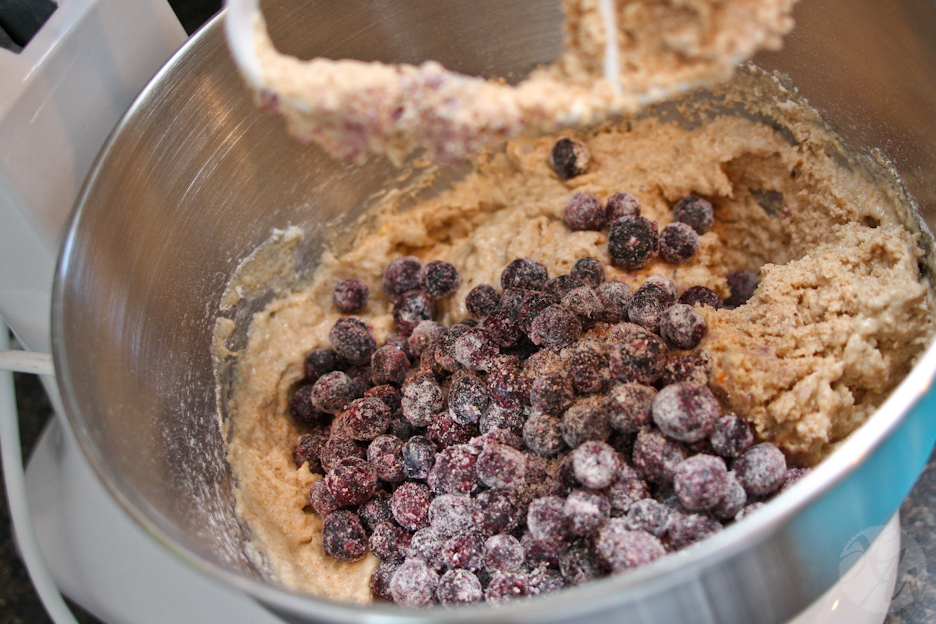
2. Whisk the sugar, oil, egg, yogurt, vanilla and zest together in bowl A. Sift together the flour, baking powder, baking soda, and salt into bowl B (which by the way should be the larger of the two bowls). Toss the berries with one tablespoon of this dry mixture and set aside.
3. Dump bowl A into bowl B. Stir it a dozen or so times, add 6 ounces of the berries to the batter and stir three more times, then just walk away for 1 minute.
4. Use a disher to spoon 1/4 cup of batter into each hole of the muffin pan.
5. Broadcast the remaining 2 ounces of berries on top of the muffins and press down on them ever so slightly.
6. Let the muffins sit for 3 minutes on the counter.
7. Bake on the middle rack of the oven for 25 to 30 minutes, until the internal temperature reaches 210°F or a toothpick inserted into the center of a muffin comes out clean. If your oven has a history of uneven baking, rotate the pan halfway through.*
8. Remove from the oven. Cover with a clean dish towel and flip the muffins out so that the bottoms are facing up.
9. Serve immediately or store in an airtight container for 2 to 3 days.
* I actually baked mine at 400°F for about 20 minutes, inspired by a post on TheKitchn that suggested how you can get a higher, more domed muffin top by increasing the heat.
They turned out wonderfully. They're healthier than most any giant muffin you'll find at your favorite coffee shop, so it's a no-guilt treat! I'm going to keep a few fresh on hand to eat in the next few days, and the rest are going in the freezer for many breakfasts to come. Alton Brown once again pulls through for me and offers up a fantastic recipe.
I also need to do some baking, because I've been accumulating supplies and I don't think I can fit anything more in my pantry.
Sounds to me like it's time to fire up the stand mixer, heat up the oven, and break in my muffin pan!
"Good muffins" to me need to have two key factors: 1) They need to be reasonably good for me, so I'm not feeling guilty about the fact that I shouldn't be eating them, and 2) they need to be tasty to really satisfy that hunger in the first place. If they taste like cardboard, then what's the point of eating them at all?
It's a tough equation.
I chose a recipe by Alton Brown (who I'm loving more and more with every recipe I make) that I found in his Good Eats 2 cookbook. I can't seem to follow a recipe without making any changes, so I made some substitutions. Here's his original recipe:
Blueberry Muffins
Makes 12-15 muffins
7 ounces sugar
1/2 cup vegetable oil
1 large egg
1 cup plain yogurt
1 teaspoon vanilla extract
1/2 teaspoon orange zest, grated
12.5 ounces all-purpose flour
2 teaspoons baking powder
1 teaspoon baking soda
1 heavy pinch kosher salt
8 ounces fresh blueberries
And I substituted:
1/2 cup applesauce instead of oil
1 cup plain Greek yogurt instead of standard yogurt
12.5 ounces whole wheat flour instead of all-purpose white
8 ounces frozen blueberries instead of fresh (and according to Alton, you should not thaw them out before adding them to the mix -- dump them in frozen)
Directions:
1. Heat the oven to 350°F*. Spray a standard 12-cup muffin pan with nonstick spray and set aside.
2. Whisk the sugar, oil, egg, yogurt, vanilla and zest together in bowl A. Sift together the flour, baking powder, baking soda, and salt into bowl B (which by the way should be the larger of the two bowls). Toss the berries with one tablespoon of this dry mixture and set aside.
3. Dump bowl A into bowl B. Stir it a dozen or so times, add 6 ounces of the berries to the batter and stir three more times, then just walk away for 1 minute.
4. Use a disher to spoon 1/4 cup of batter into each hole of the muffin pan.
5. Broadcast the remaining 2 ounces of berries on top of the muffins and press down on them ever so slightly.
6. Let the muffins sit for 3 minutes on the counter.
7. Bake on the middle rack of the oven for 25 to 30 minutes, until the internal temperature reaches 210°F or a toothpick inserted into the center of a muffin comes out clean. If your oven has a history of uneven baking, rotate the pan halfway through.*
8. Remove from the oven. Cover with a clean dish towel and flip the muffins out so that the bottoms are facing up.
9. Serve immediately or store in an airtight container for 2 to 3 days.
* I actually baked mine at 400°F for about 20 minutes, inspired by a post on TheKitchn that suggested how you can get a higher, more domed muffin top by increasing the heat.
They turned out wonderfully. They're healthier than most any giant muffin you'll find at your favorite coffee shop, so it's a no-guilt treat! I'm going to keep a few fresh on hand to eat in the next few days, and the rest are going in the freezer for many breakfasts to come. Alton Brown once again pulls through for me and offers up a fantastic recipe.
Thursday, February 3, 2011
143/365 Breakfast: snack to follow it
We made it through the ice storm much more easily than predicted (thank goodness), and I didn't need to tap into any of my gallons of water I'd prepared. So, let's finish up this breakfast theme so we can move to something new!
I give myself a lot of time to wake up, eat breakfast, clean up and get dressed, finish gathering my lunch items, and get out the door for work every morning. I could do it faster, but I like the more laid-back pace of the morning; when I wake up and have to start rushing, I feel like it gets my day started on the wrong note.
Since I do get up so early (before 6:00 a.m.), that means lunch at noon is a long time away. Even with a good-sized breakfast with plenty of protein and fiber content, I'm hungry by 10:00. And trying to concentrate with a growling stomach for another two hours is torture. Pure agony.
Enter: the mid-morning snack.
I take an orange, an apple, a banana -- whatever fresh fruit I have on hand -- with me to work every day to curb that starvation and hold me over until lunch. It makes a huge difference (and it doesn't take much convincing to get me to eat fruit...yum!). Citrus is plentiful right now, so my desk has been seeing many oranges recently.
What's your favorite mid-morning snack?
Camera: Canon 40D, 1/60s, f/4.5 at ISO 1000 under fluorescent lighting
I give myself a lot of time to wake up, eat breakfast, clean up and get dressed, finish gathering my lunch items, and get out the door for work every morning. I could do it faster, but I like the more laid-back pace of the morning; when I wake up and have to start rushing, I feel like it gets my day started on the wrong note.
Since I do get up so early (before 6:00 a.m.), that means lunch at noon is a long time away. Even with a good-sized breakfast with plenty of protein and fiber content, I'm hungry by 10:00. And trying to concentrate with a growling stomach for another two hours is torture. Pure agony.
Enter: the mid-morning snack.
I take an orange, an apple, a banana -- whatever fresh fruit I have on hand -- with me to work every day to curb that starvation and hold me over until lunch. It makes a huge difference (and it doesn't take much convincing to get me to eat fruit...yum!). Citrus is plentiful right now, so my desk has been seeing many oranges recently.
What's your favorite mid-morning snack?
Camera: Canon 40D, 1/60s, f/4.5 at ISO 1000 under fluorescent lighting
Monday, January 17, 2011
136/365 Starfruit from Florida
For the past few months, I've been working with a nutritionist to see if I can make some health improvements through eating habits alone. It's been an interesting learning process, and it's definitely an adjustment!
One of my fears going in was that she would tell me to cut dairy products out of my life, and I love dairy. Milk, cheese, yogurt, ice cream... serve it up! Sure enough, one of her first recommendations was to cut back on it. Surprisingly, it hasn't been as difficult as I expected it to be. Soy milk isn't an option, but I've found that the So Delicious milk substitute made from coconut milk is very good, and I learned I can live with goat's milk, as well (go figure).
At our last meeting, she brought me a couple of starfruit from her sister-in-law's tree in Florida. I can't imagine having these growing on a tree in the yard! I'm so used to Midwestern fare like berries and apples that it's strange to think about having your own starfruit -- or even orange -- tree in the yard.
I have to say, though, the starfruit was fun to photograph, but not so great to eat. It had no real flavor, and I expected it to be sweeter. It may not have been quite ripe, so I'll try giving it the benefit of the doubt.
Camera: Canon 40D with 60mm macro lens, 1/250s, f/4 at ISO 100 by a window in natural light at about 4:00 p.m.
One of my fears going in was that she would tell me to cut dairy products out of my life, and I love dairy. Milk, cheese, yogurt, ice cream... serve it up! Sure enough, one of her first recommendations was to cut back on it. Surprisingly, it hasn't been as difficult as I expected it to be. Soy milk isn't an option, but I've found that the So Delicious milk substitute made from coconut milk is very good, and I learned I can live with goat's milk, as well (go figure).
At our last meeting, she brought me a couple of starfruit from her sister-in-law's tree in Florida. I can't imagine having these growing on a tree in the yard! I'm so used to Midwestern fare like berries and apples that it's strange to think about having your own starfruit -- or even orange -- tree in the yard.
I have to say, though, the starfruit was fun to photograph, but not so great to eat. It had no real flavor, and I expected it to be sweeter. It may not have been quite ripe, so I'll try giving it the benefit of the doubt.
Camera: Canon 40D with 60mm macro lens, 1/250s, f/4 at ISO 100 by a window in natural light at about 4:00 p.m.
Thursday, December 30, 2010
131/365 Outnumbered by sweet goodness
I had to laugh when I walked in the lunch room at work and saw this.
Finding a haul of sweets in the office at this time of year is a given. My willpower certainly gets a workout in the weeks before Christmas!
Finding a clementine on a plate with taffy and cupcakes? Now that's something you don't see every day. Kudos to the person who tried to inject some healthy food into the mix, but I think they were outnumbered!
Camera: Canon 40D, 1/100s, f/4 at ISO 640 under fluorescent lighting
Finding a haul of sweets in the office at this time of year is a given. My willpower certainly gets a workout in the weeks before Christmas!
Finding a clementine on a plate with taffy and cupcakes? Now that's something you don't see every day. Kudos to the person who tried to inject some healthy food into the mix, but I think they were outnumbered!
Camera: Canon 40D, 1/100s, f/4 at ISO 640 under fluorescent lighting
Thursday, September 30, 2010
102/365 Smoothie material
My go-to breakfast when the weather is warm is a good, cold smoothie. This summer I've learned why bananas are such a mainstay ingredient in smoothie recipes -- they add a real, tangible creaminess to it unlike any other fruit.
I like to buy a big bunch of bananas at the grocery store, slice them onto a cookie sheet, and stick them in the freezer overnight. By morning, I have enough pre-sliced, frozen bananas to start at least a week's worth of smoothies.
Want to know something else about that frozen banana? You can make one-ingredient ice cream with it! Dump a couple frozen bananas in a blender and go -- after a few rounds of scraping the contents down the sides of the bowl, you've got creamy soft-serve ice cream. It's fascinating!
Hungry now?
Camera: Canon 40D with 60mm macro lens and 430EX Speedlite, 1/125s, f/2.8 at ISO 640
I like to buy a big bunch of bananas at the grocery store, slice them onto a cookie sheet, and stick them in the freezer overnight. By morning, I have enough pre-sliced, frozen bananas to start at least a week's worth of smoothies.
Want to know something else about that frozen banana? You can make one-ingredient ice cream with it! Dump a couple frozen bananas in a blender and go -- after a few rounds of scraping the contents down the sides of the bowl, you've got creamy soft-serve ice cream. It's fascinating!
Hungry now?
Camera: Canon 40D with 60mm macro lens and 430EX Speedlite, 1/125s, f/2.8 at ISO 640
Thursday, June 24, 2010
49/365 Indiana wine country
I don't ordinarily think of grapes being grown in Indiana, but I think that has more to do with my awareness rather than a statement about the land and climate. Exhibit A: My parents' grape vines are loaded with fruit this year.
Indianapolis Monthly actually published an article last year about the owner of Oliver Winery in Bloomington and his belief that Indiana is actually a great place to grow grapes and produce wine. I found the article to be really interesting, and it gave me some different insight into the ins and outs of cultivating grapes for wine.
Who knows, maybe Indiana is the next big wine region on the horizon!
Camera: Canon 40D, 1/125s, f/4 at ISO 100 at about 5:30 p.m.
Indianapolis Monthly actually published an article last year about the owner of Oliver Winery in Bloomington and his belief that Indiana is actually a great place to grow grapes and produce wine. I found the article to be really interesting, and it gave me some different insight into the ins and outs of cultivating grapes for wine.
Who knows, maybe Indiana is the next big wine region on the horizon!
Camera: Canon 40D, 1/125s, f/4 at ISO 100 at about 5:30 p.m.
Thursday, June 17, 2010
44/365 Tart cherries
My family's little cherry tree has produced its annual offering of tart cherries. Unfortunately, I missed the chance to visit the tree and pluck off a few right there, but I'm counting on being able to enjoy part of the crisp made with the harvest!
I was never a huge fan of fresh cherries until I met a tart one, and I found them to be completely addicting and incomparable -- especially when I got to enjoy them standing right beside the tree. Now I'll get a batch of sweet cherries when they're ripe, but they don't hold a candle to the ones picked fresh off the tree.
Camera: Canon 40D with 60mm macro lens, 1/250s, f/5.6 at ISO 100 at about 6:30 p.m.
I was never a huge fan of fresh cherries until I met a tart one, and I found them to be completely addicting and incomparable -- especially when I got to enjoy them standing right beside the tree. Now I'll get a batch of sweet cherries when they're ripe, but they don't hold a candle to the ones picked fresh off the tree.
Camera: Canon 40D with 60mm macro lens, 1/250s, f/5.6 at ISO 100 at about 6:30 p.m.
Wednesday, February 10, 2010
312/365 Winter citrus
One bright spot in the dead of winter: citrus fruit.
Yum.
My Farm Fresh Delivery bin once again came stuffed with some great produce and willing photography subjects, including some excellent grapefruit, pictured here.
Eating grapefruit always poses an interesting challenge. I don't know anyone who peels it and eats the slices like an orange. So that means you have to slice it another way, and many methods end up leaving a lot of the juicy fruit behind.
The easiest way? Just slice the darn thing in half and grab a spoon. Even though that means wiping up some juice splatters, it doesn't keep me away!
Camera: Canon 40D with 60mm macro lens, 1/125s, f/2.8 at ISO 125 at about 10:00 a.m. on an east-facing window ledge.
Yum.
My Farm Fresh Delivery bin once again came stuffed with some great produce and willing photography subjects, including some excellent grapefruit, pictured here.
Eating grapefruit always poses an interesting challenge. I don't know anyone who peels it and eats the slices like an orange. So that means you have to slice it another way, and many methods end up leaving a lot of the juicy fruit behind.
The easiest way? Just slice the darn thing in half and grab a spoon. Even though that means wiping up some juice splatters, it doesn't keep me away!
Camera: Canon 40D with 60mm macro lens, 1/125s, f/2.8 at ISO 125 at about 10:00 a.m. on an east-facing window ledge.
Tuesday, November 17, 2009
231/365 Fresh kiwi
My Farm Fresh Delivery bin this last time contained some wonderful kiwi. I never think of them as a fall/winter fruit, but I guess they are!
At least they're a fresh fruit in California at this time of year. And that makes me wonder about the kiwi I had in April of 2008: that's six months' difference. Where did that kiwi come from? FFD concentrates on providing local and U.S.-produced food, so I know this one came from the States. The standard grocery store isn't quite as conscious, so who knows where the April kiwi originated.
Makes you wonder, doesn't it?
Camera: Canon 40D with 60mm macro lens and 430EX Speedlite, 1/125s, f/2.8 at ISO 400
At least they're a fresh fruit in California at this time of year. And that makes me wonder about the kiwi I had in April of 2008: that's six months' difference. Where did that kiwi come from? FFD concentrates on providing local and U.S.-produced food, so I know this one came from the States. The standard grocery store isn't quite as conscious, so who knows where the April kiwi originated.
Makes you wonder, doesn't it?
Camera: Canon 40D with 60mm macro lens and 430EX Speedlite, 1/125s, f/2.8 at ISO 400
Wednesday, September 2, 2009
164/365 Deceiving peaches
Fresh peaches have to be one of my favorite kinds of fruit. But the window of opportunity for finding them when they're in their prime is pretty narrow.I had a handful of really good peaches a week or so ago, but when I went back to the same grocery store and bought more, I was too late.
They look deceivingly good on the outside, but they're going bad from the inside out.
I hate when that happens!
Each one I've sliced has been overly soft in the middle, not wanting to separate from the pit, with even some rotting spots starting to radiate out from the core of the fruit. It's not an appetizing sight.
At least they looked nice enough for a day's photo.
Camera: Canon 40D with 60mm macro lens and 430EX Speedlite, 1/125s, f/2.8 at ISO 400
Tuesday, June 9, 2009
79/365 An earlier season
This blog has proven to be useful in more ways than one, and in this case, it's serving as seasonal documentation.In what way specifically? I've found that the cherries have ripened several weeks earlier this year than last.
Last year, I posted my photo of ripening cherries on June 15. And we picked them and made crisp on June 22.
This year? We picked and enjoyed our cherry crisp on June 8. The cherries on the tree in this photo are post-picking.
I wonder, what aspect of our difference in seasons made the cherries ripen early? Is that a good thing, a bad thing, or just a thing?
Camera: Canon 40D with 60mm macro lens, 1/125s, f/2.8 at ISO 250 at about 7:30 p.m.
Sunday, May 3, 2009
41/365 When should I buy organic?
I'm all in favor of the return to eating more organically produced foods. But until we see more options readily available at the grocery store -- at a comparable price -- it's going to take some time for society to completely make the switch.If you're just dipping your toe into the organic-shopping pool, where do you start? Are there some foods that you should definitely buy organic, and others you can buy normally?
Both of these questions have crossed my mind. And this past week, I found a good answer in a surprising location, one where I wouldn't necessarily think to look for guidance on healthy shopping: the March issue of Glamour magazine (yes, it's May, and I'm a little behind in my reading).
The article is titled, "Five foods every woman should eat organic," but the information applies to both men and women.
One of the five foods recommended is an apple because of the high levels of toxic pesticides used (and they're in close company with nectarines, peaches, pears, strawberries, cherries and imported grapes), but what's also interesting in this section are three fruits you don't have to worry about buying organic: oranges, bananas and pineapples.
Why? Think about what makes these fruits different than those earlier in the list -- they have thick, durable skins that you peel or slice off before eating it. You may peel an apple, but it's not a requirement, and the skin is only a thin barrier between the fruit and the outside world.
Interesting! I recommend reading the whole article, man or woman. It makes what can be an overwhelming shopping trip (mentally and financially) a little more manageable.
Camera: Canon 40D with 60mm macro lens and 430EX Speedlite, 1/125s, f/2.8 at ISO 400
Thursday, April 23, 2009
32/365 Cherry blossoms
This lovely little cherry tree has been a favorite subject of mine, but this is the first I've photographed its blossoms instead of its luscious fruit.Curious about the story of this little tree? Check out these posts from Year 1:
34/365 -- How this little tree came to be...
92/365 -- Full of fresh fruit
99/365 -- A modest but wonderful harvest
I adore the bright green grass that acts as a backdrop for the bright white blossoms in this photo. The wind presented a challenge, but I fought back with patience and a sufficiently fast shutter speed.
I can't wait for the fruit!
Camera: Canon 40D with 60mm macro lens, 1/125s, f/5.6 at ISO 640 at about 8:00 p.m.
Subscribe to:
Posts (Atom)